
Ask most people which burns more fat - walking or running - and they will say running, without hesitation. Running is harder. It feels more intense. It leaves you breathless and sweating in a way that a stroll through the park does not. Surely the more demanding activity must be burning more fat. The logic is intuitive, and it is also incomplete. Because the relationship between exercise intensity, calorie burn, and fat oxidation is considerably more nuanced than effort alone suggests - and understanding that nuance can genuinely change how you approach your fitness routine.
The short answer is that running burns more total calories, but walking burns a higher proportion of those calories from fat. Both statements are true simultaneously. What that means in practice depends on your goals, your fitness level, and how much time you have available. Let's work through the science properly.
How the Body Fuels Exercise
Your body draws on two primary fuel sources during physical activity: carbohydrates, stored as glycogen in the muscles and liver, and fat, stored in adipose tissue and within muscle cells as intramuscular triglycerides. The ratio in which these two fuels are used shifts dramatically depending on exercise intensity, and that shift is at the heart of the walking versus running debate.
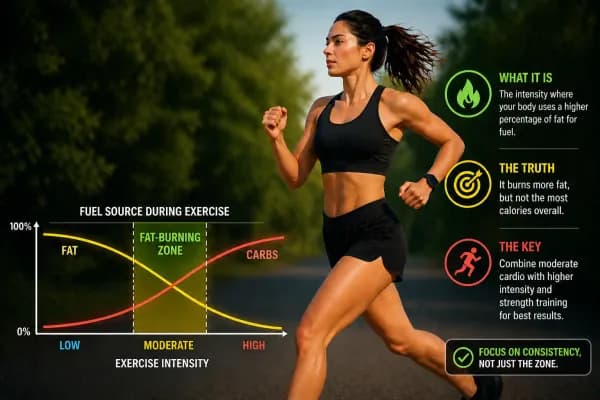
At low to moderate intensities - think brisk walking or a very easy jog - the body is aerobically efficient. Oxygen is plentiful, the aerobic energy system is running smoothly, and fat is the preferred fuel. Fat oxidation, the process of breaking down stored fat for energy, is relatively slow but highly efficient at these intensities. The body essentially has time to process fat properly. As intensity rises toward vigorous running, the demand for energy outpaces the speed at which fat can be mobilised and oxidised. The body shifts increasingly toward glycogen - a faster-burning fuel - to meet the demand. This is why a slow walk feels sustainable almost indefinitely, while a hard run depletes you in minutes. Walking (60% max HR) ~60% of calories burned from fat Running (80% max HR) ~35% of calories burned from fat.
The Fat-Burning Zone: Real, but Misunderstood
The so-called fat-burning zone - typically described as 60 to 70 percent of your maximum heart rate - is a real physiological phenomenon, not a marketing myth. At this intensity, which corresponds roughly to a brisk walk or a very easy jog, fat contributes the greatest proportion of fuel relative to carbohydrate. The misunderstanding arises when people interpret this to mean that walking is therefore superior to running for fat loss. The proportion of fat burned is only part of the picture.

Consider the arithmetic. If you walk for 30 minutes and burn 150 calories, and 60 percent of those come from fat, you have burned 90 fat-derived calories. If you run for the same 30 minutes and burn 300 calories, and only 35 percent come from fat, you have burned 105 fat-derived calories. Running wins on absolute fat calories burned per unit of time - even though it uses a lower proportion of fat as fuel. The fat-burning zone is real. The claim that it makes walking more effective for fat loss than running is not.
"Fat loss is ultimately governed by total energy balance. The question is not which fuel you burn during exercise - it is how much total energy you expend across the day."
Calories Per Mile: A Surprising Equaliser
Here is where the picture becomes genuinely interesting. When you compare walking and running not by time but by distance, the calorie difference narrows considerably. Research suggests that walking and running one mile burns a roughly similar number of calories for a given body weight - approximately 80 to 100 calories per mile for most adults, regardless of pace. The reason is mechanical efficiency: covering a mile requires moving your body mass over that distance, and the energy cost of doing so does not change dramatically whether you walk it in 20 minutes or run it in 8.
Running is faster, which means you cover more distance - and burn more calories - per unit of time. But per mile, the gap is smaller than most people assume. This matters practically: if you have 45 minutes available and choose to walk rather than run, you will cover fewer miles and burn fewer calories overall. But if you are comparing a 3-mile walk to a 3-mile run, the caloric difference is modest. The walker simply took longer to get there.
Afterburn: Running's Hidden Advantage
Running holds another advantage that does not show up during the workout itself: excess post-exercise oxygen consumption, commonly known as EPOC or the afterburn effect. After intense exercise, the body continues to consume oxygen at an elevated rate as it recovers - repairing muscle tissue, replenishing glycogen stores, clearing metabolic byproducts, and returning physiological systems to baseline. This elevated metabolism can persist for hours after a hard run, burning additional calories - predominantly from fat - long after you have stopped moving.
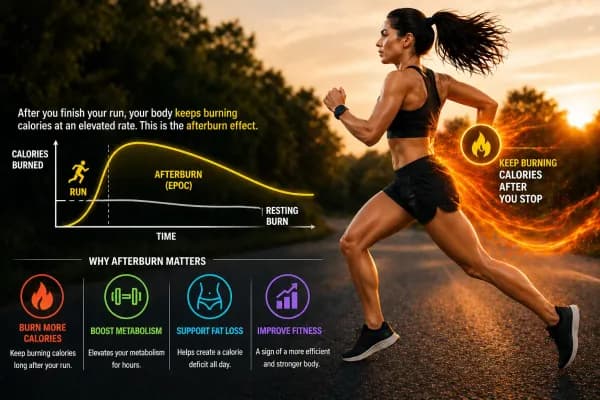
Walking produces a negligible afterburn effect by comparison. The intensity simply is not high enough to meaningfully disrupt homeostasis. A vigorous 30-minute run might elevate your metabolism for two to four hours post-exercise, adding 50 to 150 additional calories burned depending on the individual and the intensity. Over weeks and months, this compounds. It is one of the reasons that interval running — alternating hard efforts with recovery periods - is particularly effective for body composition changes.
The Case for Walking
None of the above should be read as a dismissal of walking. Walking has a compelling case that running simply cannot match in several important areas. It is sustainable for almost everyone regardless of fitness level, age, or joint health. It produces no meaningful muscle damage or recovery demands, which means it can be performed daily without the accumulated fatigue that running generates. It is associated with lower injury rates - the chronic knee, hip, and plantar fascia injuries that derail so many runners' routines do not tend to afflict walkers. And crucially, a 45-minute walk that actually happens every day is infinitely more valuable for fat loss than a 30-minute run that is skipped three times per week because of soreness, fatigue, or dread.
There is also a growing body of research supporting non-exercise activity thermogenesis - NEAT — the calories burned through all movement that is not formal exercise: walking to a meeting, taking the stairs, pacing while on a phone call. Consistent walkers tend to accumulate far more daily movement than runners who have expended their energy budget on a single intense session and then sit for the remainder of the day. Total daily movement, not just workout duration, is a powerful driver of calorie expenditure and metabolic health.
Who Should Walk, Who Should Run
The practical answer to which activity is better for fat loss depends on the individual standing in front of you. For someone who is new to exercise, significantly overweight, managing joint pain, or returning from injury, walking is not a consolation prize - it is genuinely the correct tool. The calorie deficit it creates, combined with the sustainability that keeps the habit alive, makes it highly effective for fat loss over time. Attempting to run before the body is ready leads to injury, discouragement, and abandonment of the routine entirely.
For someone who is already fit, has no injury concerns, and wants to maximise fat loss efficiency within a limited time window, running - particularly interval-based running such as high-intensity interval training - offers a clear advantage in calories burned per minute and total metabolic impact. The afterburn effect, greater calorie expenditure per session, and the muscle-building stimulus of harder efforts all tip the balance toward running for the time-efficient exerciser.
The Smartest Approach: Use Both
Framing walking and running as competitors misses the most intelligent answer. A well-designed fitness routine uses both, assigning each where it is most appropriate. Two to three running sessions per week — one longer easy run, one interval session, one moderate-paced run - deliver the cardiovascular stimulus, afterburn effect, and calorie expenditure that drive fat loss. Daily walking - whether structured or simply accumulated through deliberate movement choices - adds to total energy expenditure without recovery cost, keeps the metabolism active on rest days, and supports the joint health that sustains a running habit over years rather than months.
Fat loss, at its most fundamental level, is a function of sustained calorie deficit over time. The best exercise for that purpose is not the one that burns the most calories in a single session. It is the one you can do consistently, progressively, and without breaking your body in the process. Walking and running together - each doing what it does best - get you there faster than either could alone.
Running burns more total calories and more absolute fat per session. Walking burns a higher proportion of fat and is more sustainable daily. For maximum fat loss, combine both: run two to three times per week for intensity and afterburn, walk daily to keep total movement high. The winner is whichever one you actually keep doing.