
The conventional wisdom around fitness was built for people with conventional schedules. Wake up early, drive to the gym, spend an hour working out, shower, commute, and somehow still arrive at work on time. For most working professionals - those managing meetings, deadlines, travel, and the ordinary chaos of adult life - that model collapses almost immediately. It isn't a lack of motivation that derails people. It's the sheer impracticality of a routine that demands so much logistical overhead before a single rep is performed.
Home workouts solve the logistical problem entirely. No commute, no wait for equipment, no locker rooms. But without structure, working out at home tends to dissolve into vague intentions. The goal of this plan is to give you something concrete: a framework flexible enough to survive a real professional life, yet structured enough to actually produce results.
The Core Principle: Minimum Effective Dose
Exercise science has increasingly supported what time-strapped professionals have long suspected - you don't need to work out for an hour to see meaningful benefits. Research consistently shows that 20 to 30 minutes of focused, well-designed exercise, performed four to five times per week, is sufficient for maintaining cardiovascular health, building functional strength, and managing body composition. The key word is focused. Intentional effort with minimal idle rest does far more than an hour of wandering through a gym floor.
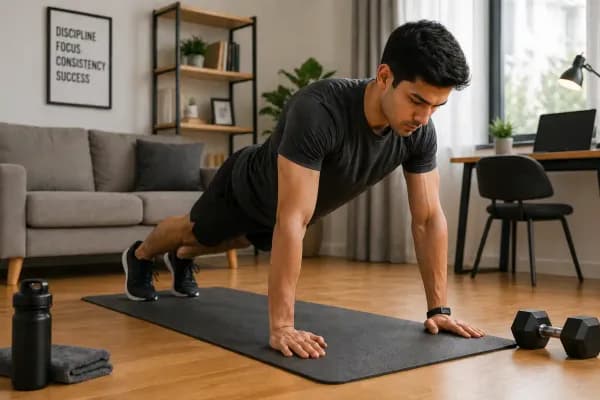
This plan is built around that principle. Every session is designed to be completed in 25 to 30 minutes, with no equipment required beyond your own bodyweight and a small patch of floor space.
The enemy of a sustainable fitness routine is not laziness - it is complexity. Simplify the entry point and the habit follows.
The Weekly Structure
Rather than dividing workouts by isolated muscle groups, this plan uses a push, pull, and full-body rotation across the week. Monday and Thursday are push days, targeting the chest, shoulders, and triceps. Tuesday and Friday shift focus to pulling and hinging movements - the back, biceps, and posterior chain. Wednesday and Saturday are full-body circuit days that blend strength and cardiovascular conditioning in a single compact session. Sunday is reserved for rest or gentle movement such as a 20-minute walk or a stretching routine.
This structure ensures every major muscle group is trained twice per week - the frequency generally recommended for strength and hypertrophy gains - without requiring more than 30 minutes on any given day. If your week contracts further, the plan scales: three days of full-body circuits produce meaningful results on their own.
Push Day: Chest, Shoulders and Triceps
Push days are built around pressing movements that require nothing but the floor and your own bodyweight. The session opens with Standard Push-Ups as a baseline strength exercise, performed with a slow three-second lowering phase to maximise muscle engagement. From there, Wide Push-Ups shift emphasis toward the outer chest, while Diamond Push-Ups - hands forming a triangle under the sternum - isolate the triceps with precision. Pike Push-Ups, performed with hips raised high so the body forms an inverted V, replicate the overhead pressing pattern and are genuinely effective for shoulder development. A set of Tricep Dips off the edge of a sturdy chair rounds out the session, targeting the back of the arms through a full range of motion. Perform each exercise for 40 seconds, rest for 20, and complete three rounds.
Pull & Hinge Day: Back, Biceps and Glutes
Pull and hinge days address the muscles that desk workers neglect most - and the ones most responsible for good posture and lower back health. Doorframe Rows, performed by gripping both sides of a doorframe and leaning back at an angle before pulling the chest forward, train the upper back effectively without a single piece of equipment. Table Rows — lying under a sturdy dining table and pulling the chest up to the surface - add genuine pulling resistance for the lats and biceps. For the posterior chain, Glute Bridges and their single-leg variation target the glutes and hamstrings through a full hip extension. Single-Leg Romanian Deadlifts develop hip hinge mechanics, balance, and lower-body strength simultaneously. Finishing with Superman Hold repetitions - lying prone and lifting arms and legs off the floor - activates the often-neglected spinal erectors and upper back.
Full-Body Circuit Day: Strength Meets Conditioning
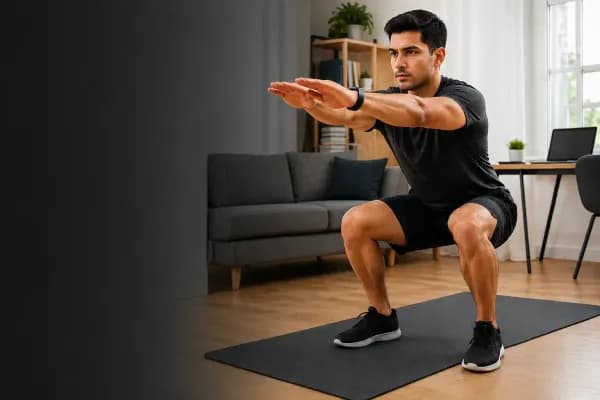
Wednesday and Saturday sessions are where the cardiovascular work happens. The circuit combines compound strength movements with exercises that spike the heart rate, delivering a session that trains the whole body while burning meaningful calories. Bodyweight Squats anchor the lower body work, progressing over weeks to Jump Squats for added conditioning. Reverse Lunges follow, training each leg unilaterally to correct imbalances. Mountain Climbers - a plank position with alternating knee drives performed rapidly - elevate the heart rate immediately while training core stability. Burpees are included sparingly: one round of 10 is enough to challenge any fitness level. Plank to Downward Dog transitions build shoulder endurance and spinal mobility together. The session ends with Dead Bugs, a core exercise performed lying on the back with alternating arm and leg extensions, which trains deep abdominal stability in a way that crunches simply cannot replicate.
The Schedule You'll Actually Keep
The single greatest predictor of long-term fitness success is not the quality of your program. It is consistency. And consistency is a product of habit design, not willpower. Attach your workout to an existing anchor in your day - the minutes immediately after morning coffee, the gap between lunch and your first afternoon meeting, or the transition from workday to evening. When the decision about when to work out has already been made in advance, the daily negotiation with yourself disappears.
Prepare the night before. Put your workout clothes out. Clear a patch of floor. On the mornings when motivation is low - and those mornings will come - you are not relying on enthusiasm. You are relying on a frictionless environment and the quiet force of a small, established habit.
Progression: Getting Harder Over Time
After four to six weeks of consistent training, your body will adapt to the demands placed on it. This is a success - it means you have gotten fitter. But it also means you need a new stimulus to continue progressing. Shorten rest intervals from 20 to 15 seconds. Add a fourth round to each circuit. Graduate from Standard Push-Ups to Archer Push-Ups, which load one arm at a time and dramatically increase difficulty. Move from Bodyweight Squats to Pistol Squat progressions. A filled backpack adds resistance to lunges and squats without a single piece of gym equipment. Track your sessions in a notes app. Progress recorded is progress sustained.
Rest, Recovery, and the Long Game
Professionals are often better at working harder than at resting intelligently. Recovery is not laziness - it is where adaptation actually happens. Muscle fibres repair and grow stronger during rest, not during training. Sleep is the single most powerful recovery tool available, and it costs nothing. Seven to nine hours of quality sleep per night will do more for your physical progress than any supplement or advanced technique.
What you are building here is not a short-term intervention. It is a sustainable physical practice that fits around a demanding career - one that will still be running five years from now. The best workout plan is not the most sophisticated one. It is the one you actually do, consistently, with the time you actually have.