
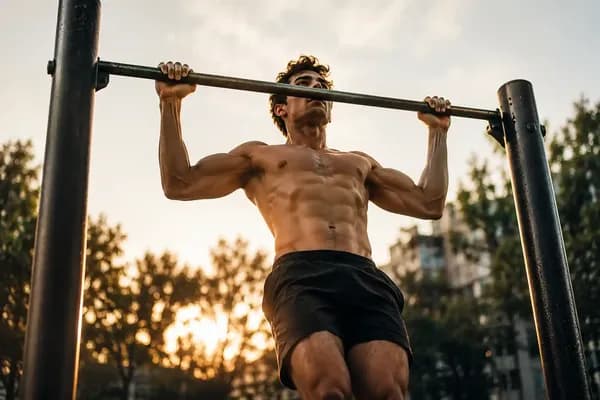
Walk into any park in Tokyo, Barcelona, or New York, and you'll find them — people performing movements that look almost impossible. A man suspended parallel to the ground, held up by only his straight arms. A woman flowing through a slow, controlled handstand push-up. A teenager knocking out thirty perfect pull-ups without breaking a sweat.
This is calisthenics. And if you've never explored it seriously, you may be missing the most accessible, scalable, and transferable form of strength training that exists.
The word comes from the Greek kalos (beauty) and sthenos (strength) — beautiful strength. It's a fitting name for a discipline that develops power, control, and aesthetics simultaneously, using little more than your own bodyweight and a pull-up bar.
"Strength is not just about how much you can lift — it's about how well you can control what you already carry." — A principle at the heart of calisthenics training.
What Is Calisthenics?
Calisthenics is a form of strength training that uses bodyweight movements as resistance. Push-ups, pull-ups, dips, squats, and holds — these are the building blocks. What makes the discipline compelling is its progression system. Every movement has an easier and a harder variation, which means the practice scales with you from day one to year ten.
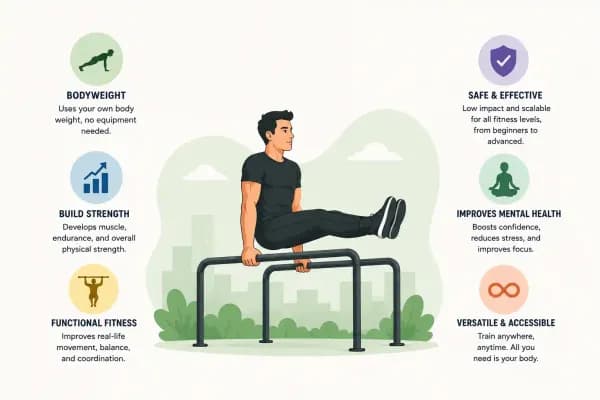
Beginners start with incline push-ups and bodyweight squats. Intermediate athletes work toward pull-ups, dips, and pike push-ups. Advanced practitioners pursue front levers, handstands, and planche holds. The ceiling is remarkably high — and the floor is accessible to almost everyone.
The Core Benefits
Calisthenics builds functional strength that carries over into real life. Because every movement requires full-body stabilization, you develop muscle, coordination, and body awareness simultaneously. Many practitioners also notice genuine improvements in posture and joint health over time, largely because the movements demand proper alignment to perform correctly.
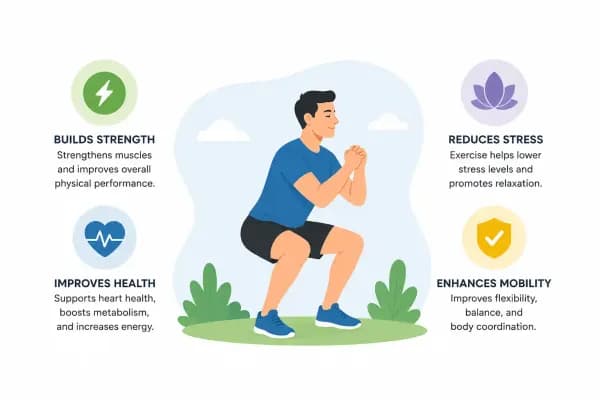
It is also remarkably practical. A pull-up bar is the only equipment you truly need to get started. Parks, floors, and walls do the rest. This makes it one of the few training systems that travels with you anywhere in the world.
The Six Foundational Movements
The push-up targets the chest, shoulders, and triceps — progressing from incline to standard, archer, pseudo planche, and planche push-up. The pull-up and chin-up develop the back, biceps, and core through a path from Australian rows and negatives to full pull-ups, L-sit pull-ups, and one-arm variations. The dip works the chest, triceps, and anterior deltoid, moving from bench dip to parallel bar, ring dip, and Korean dip — excellent for upper body mass and strength.
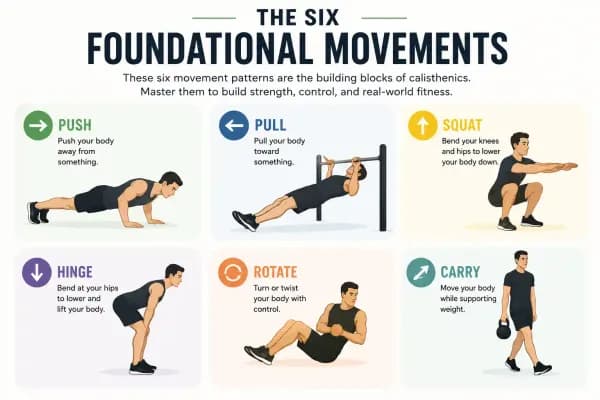
The squat trains the quads, glutes, and hamstrings through air squat, jump squat, Bulgarian split squat, and pistol squat — the pistol being a genuine strength and mobility test. The hollow body hold is the foundational gymnastics core position, progressing from bent-knee to straight-leg to hollow rock, and underlies nearly every advanced skill. The pike push-up targets the shoulders and upper back — moving from elevated pike to wall handstand to freestanding handstand push-up — and is one of the best overhead strength builders available.
A Simple Starter Plan
Three days per week is enough to make meaningful progress as a beginner. A basic structure might look like this:
Day A — Push: Push-up progression, pike push-up, dip variation, plank hold.
Day B — Pull: Pull-up or row progression, dead hang, hollow body hold.
Day C — Full Body: Squat progression, push-up, pull-up, core work.
Rest at least one day between sessions. Focus on clean form over high reps. Progress to harder variations only when the current one feels controlled and consistent.
One Thing Most Beginners Get Wrong
The most common mistake is chasing advanced skills too early. A muscle-up looks incredible — but without a solid base of pull-ups and dips, attempting one is both ineffective and potentially harmful to the shoulders and elbows. Build the foundation first. The skills come naturally once the strength is there.
Equally important is recovery. Tendons adapt more slowly than muscles, and calisthenics places real demands on the shoulders, elbows, and wrists. An extra rest day is almost always the smarter choice over training through joint soreness.
Is It Enough on Its Own?
For most people, yes — especially in the beginner and intermediate stages. Calisthenics can build substantial muscle, improve cardiovascular fitness, and develop a level of body control that gym machines simply cannot replicate. At more advanced levels, some athletes choose to add weighted vests or combine bodyweight work with barbell training to continue progressing. Both approaches are valid. Calisthenics works well as a standalone system and equally well as a complement to other training.
-600x400.webp&w=3840&q=75)